
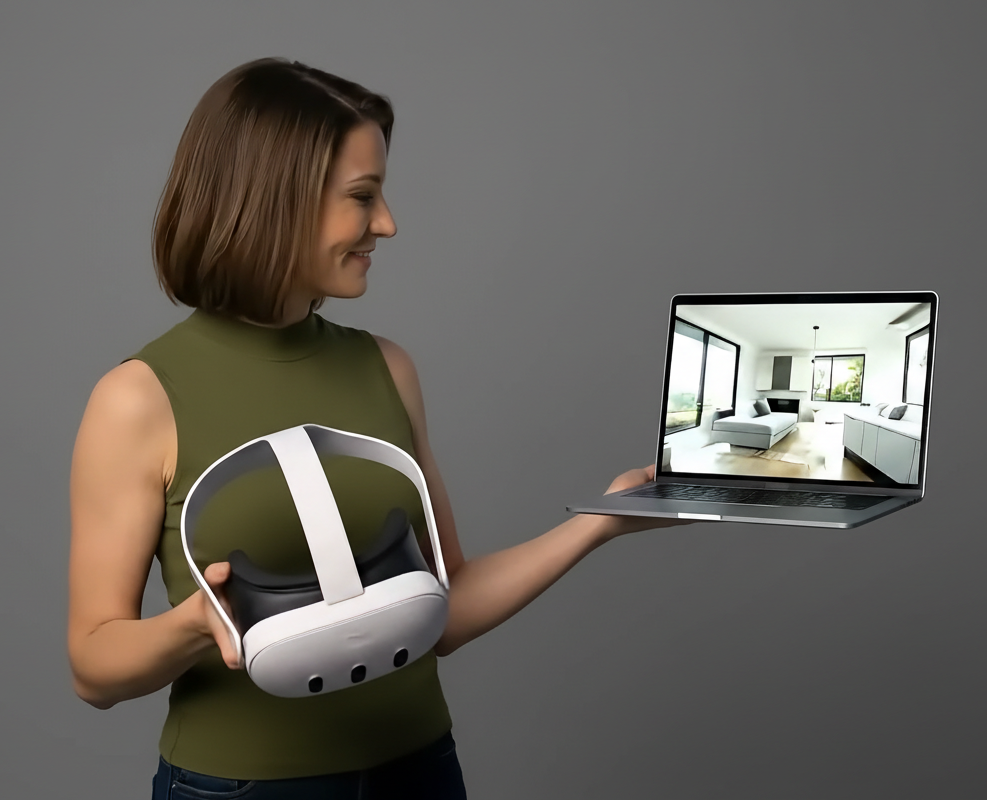
The Australian residential construction industry in 2025–2026 is valued at over $142 billion, contributes roughly 5% of Australia’s GDP, and employs more than 700,000 people. Yet when it comes to Virtual Reality (VR) and 3D virtual tours for pre-construction client presentations, adoption rates sit at just 8-12% far behind the US (20-25%) and Scandinavia (30-40%).
Why the gap? It’s not due to a lack of vision or ambition. A complex mix of financial, cultural, and structural barriers makes many traditional builders hesitant to adopt what others see as the future of client engagement.
But here’s the kicker: what if builders didn’t have to become tech companies to offer VR experiences?
What if cutting-edge virtual walkthroughs could be delivered without huge costs, months of training, or workflow disruption?
This article explores the eight major barriers preventing widespread VR adoption in Australian residential construction and shows how a service-based model can help eliminate or minimise them. The goal isn’t to criticise the industry it’s to spark thought and conversation about how technology can work for builders, not against them.
The 8 Barriers to VR Adoption in Australian Residential Construction
Before we explore solutions, it helps to understand why adoption is so slow. These barriers aren’t about resistance to innovation—they’re practical challenges that affect day-to-day operations, budgets, and workflows. They include financial constraints, training demands, workflow integration issues, and cultural perceptions around technology.
By unpacking these eight major hurdles, we can see exactly where traditional approaches fall short and how a service-based VR model can remove friction, making immersive, pre-construction visualisation accessible and practical for builders of any size.
Each barrier tells part of the story: the why behind hesitation, and the how service-based solutions can help overcome it.
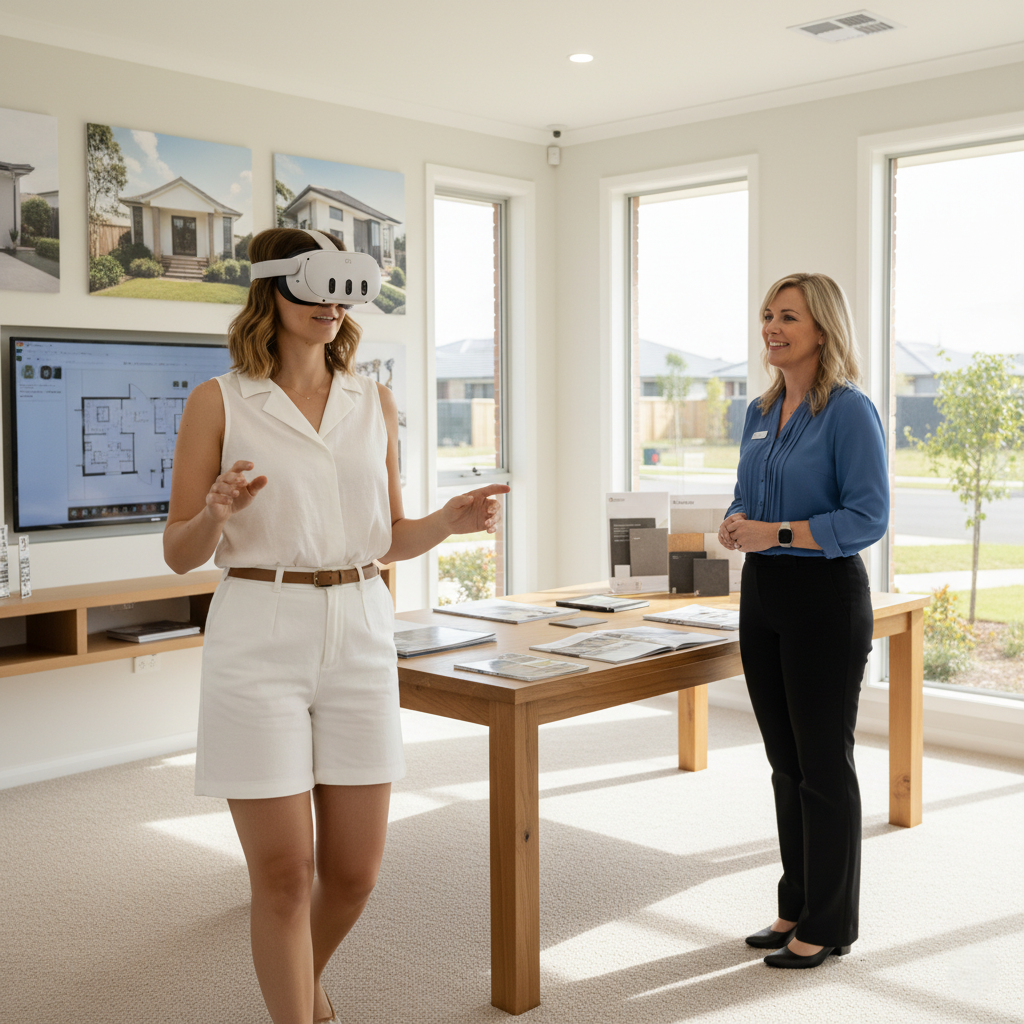
VR for pre-construction visuals isn’t “coming soon” – it’s already here just under used
1. The Financial Barrier: High Upfront Costs with Uncertain ROI
The Traditional Challenge
For a small to mid-sized builder to set up an in-house VR capability, they’re looking at:
- VR Hardware: $1,500–$3,500 per headset (Meta Quest 3, HTC Vive Pro)
- High-Performance Computers: $3,000–$8,000 per workstation
- 3D Modeling Software Licenses: $2,000–$10,000 annually (SketchUp Studio, Revit, Unreal Engine, Enscape)
- Training & Implementation: $5,000–$15,000 for staff upskilling
- Ongoing Maintenance: $3,000–$5,000 per year
Total initial investment: circa $15,000–$50,000 for a small operation.
When 98% of Australian construction businesses employ fewer than 20 people, and profit margins often sit between 5-10%, this kind of capital outlay is a non-starter. The ROI isn’t immediate and many builders simply can’t justify the risk.
The Service-Based Solution
Instead of building internal VR capabilities, builders can partner with specialist providers like PlanIt VR. The cost structure shifts entirely:
- No hardware purchase (PlanIt VR brings the equipment)
- No software licenses (handled by the service provider)
- No training required (experts manage the entire process)
- Pay-per-project model: High-quality, VR-ready 3D models priced at around $10–$15 per sqm*
* For a standard 220 sqm home, that’s $2,200-$3, 300 per project, a fraction of the $15,000-$50,000 DIY setup cost. Builders get enterprise-level VR capabilities without becoming tech companies.
2. The Skills Gap: Limited Digital Literacy and Technical Expertise
The Traditional Challenge
Even if a builder purchases VR equipment, who’s going to operate it? The typical residential construction workforce is aging (median age: 43 years), and many tradespeople and project managers have limited experience with advanced 3D modeling or game-engine software like Unreal Engine.
Creating a photorealistic VR walkthrough from architectural plans requires:
- Proficiency in BIM (Building Information Modeling) software
- High level 3D rendering skills
- Understanding of spatial design and lighting
- Technical troubleshooting for VR hardware
Most small builders don’t have in-house staff with these capabilities, and hiring or being upskilled can take months and thousands of dollars.
The Service-Based Solution
With a service model, builders send their floor plans to VR specialists who handle the entire technical workflow:
- Floor plans submitted via email or online portal
- 3D models created by experienced designers familiar with Australian building standards
- VR walkthroughs delivered ready for client presentations
- On-site support available if builders want the VR provider to run client sessions
Builders remain focused on what they do best, building homes while VR experts handle the technology.
3. Industry Fragmentation: A Sector of Small Players, Not Tech Giants
The Traditional Challenge:
Unlike industries dominated by a few large players (think tech or automotive), Australian residential construction is highly fragmented:
- 98% of businesses have fewer than 20 employees
- 87% are sole traders or small family operations
- There’s no centralised push for technology standards or adoption
This “everyone for themselves” structure means there’s no unified momentum to invest in VR. Larger commercial builders (like Multiplex or Lendlease) have adopted digital twins and VR for mega-projects, but the residential sector remains scattered and under-resourced.
The Service-Based Solution:
Service providers like PlanIt VR create economies of scale that individual builders could never achieve. By servicing hundreds of builders:
- Software licenses are amortised across many projects
- Hardware is utilised efficiently across multiple clients daily
- Best practices are standardised and refined across the industry
Small builders get access to the same technology used by major commercial contractors without needing to be big themselves.
4. Low Client Demand (For Now): The Expectation Gap
The Traditional Challenge:
In markets like Sweden and the US, homebuyers increasingly expect VR and virtual walkthroughs as a standard part of the design process. In Australia, most clients are still accustomed to 2D floor plans, despite anecdotal evidence suggesting around 40–50% of people struggle to properly understand them. Static 3D renders are often the next step, but these represent only the first rung on the visualisation ladder and are still not standard, with wide variation in quality and detail. For volume builders, physical display homes are commonly used, yet these are typically built with numerous upgrades that look impressive but may sit well beyond most purchasers’ budgets.
This raises an obvious question: how does a buyer truly experience the remaining 15–20+ floorplans a volume builder offers? In reality, they don’t. Buyers are expected to imagine the differences, interpret drawings and mentally translate plans into spaces, making one of the biggest financial decisions of their lives with only partial visual understanding. This gap between what is offered and what can be confidently understood is where misunderstandings, late-stage changes, and post-contract disappointment frequently begin.
When clients aren’t demanding VR or virtual walkthroughs, builders see little market pressure to invest. It’s a classic chicken-and-egg problem: clients don’t ask for what they don’t know exists and builders don’t offer what clients don’t request.
The Service-Based Solution:
Forward-thinking builders and architects are using VR as a competitive differentiator. When pitching against competitors, being able to say
“Before we break ground, you’ll walk through your home in full-scale VR and make changes with zero cost”
is a powerful selling point. Studies show that clients who experience VR walkthroughs during the design phase:
- Make decisions 40-60% faster (reducing design phase from 8 weeks to 5 weeks) [^1]
- Request 65-75% fewer variations during construction [^2]
- Report 30% higher satisfaction with the final build [^3]
By partnering with a VR service provider, builders can offer this premium experience without the premium investment—and clients start to expect it from future builders they work with, raising the bar industry-wide.
5.Technical Integration Challenges: VR Doesn’t Play Well with Existing Workflows
The Traditional Challenge:
Most Australian builders likely use a patchwork of software tools:
- Estimating software (Buildxact, EstimateOne)
- Project management tools (Procore, Simpro)
- Basic CAD programs (ArchiCAD, SketchUp)
Integrating VR into this ecosystem is messy. File formats don’t always convert cleanly, and creating VR-ready models from 2D PDFs requires significant manual rework. For builders who aren’t tech-savvy, this friction is enough to abandon the idea entirely.
The Service-Based Solution:
VR service providers act as the translation layer between builders’ existing workflows and VR/virtual technology. They accept:
- PDF floor plans
- DWG/CAD files
- Hand-drawn sketches (in some cases)
These are then converted into fully navigable VR or virtual environments. There’s no need for builders to change their existing estimating or project management systems. The VR layer sits on top without disrupting the core workflow.
6. Cultural Conservatism: “If It Ain’t Broke, Don’t Fix It”
The Traditional Challenge:
Construction is a relationship-driven, tradition-heavy industry. Many builders have been using the same methods for decades:
- Physical site visits
- Paper-based approvals
- Face-to-face client meetings at the display home or site office
There’s a deep-seated skepticism toward technology that feels like a “gimmick” rather than a genuine improvement. Senior builders often ask: “We’ve built hundreds of homes without VR—why start now?”
The Service-Based Solution:
The service model removes the “all-in” commitment that feels risky to conservative builders. Instead of saying:
“Invest $50,000 and change your entire business”
The pitch becomes:
“Try VR on your next project for $2,500. If your clients love it, keep using it. If not, no long-term commitment.”
This low-risk, pay-as-you-go approach makes it easier for traditional builders to dip their toes in the water. Many find that once clients experience VR, they’re hooked—and the builder gains a reputation as innovative and client-focused.
7. Regulatory Uncertainty and Contractual Considerations
The Traditional Challenge:
When clients make design decisions in VR, what’s the legal standing? If a client approves a kitchen layout in a virtual walkthrough, can they later claim it doesn’t match their expectations? Australian building contracts and consumer protection laws haven’t fully caught up with immersive technologies.
Builders worry about:
- Liability: What if VR misrepresents dimensions or finishes?
- Scope creep: Will clients use VR to endlessly tweak designs?
- Documentation: How do you record VR-based approvals for contract purposes?
The Service-Based Solution:
Professional VR service providers include documentation and approval processes as part of their offering:
- Timestamped VR session recordings
- Screenshots and annotated walkthroughs for contract attachments
- Clear disclaimers explaining that VR is a design tool, not a legally binding representation (just like 2D renders)
By working with experienced providers, builders get templates and processes that protect them legally while still delivering an immersive client experience.
8. Infrastructure and Connectivity: The Regional Divide
The Traditional Challenge:
VR experiences, especially cloud-based rendering or real-time design collaboration require robust internet connectivity. In metropolitan areas like Sydney or Melbourne, this isn’t an issue. But in regional Queensland, rural Victoria, or remote Western Australia, internet speeds can be a major bottleneck.
For builders operating in these areas, the idea of streaming high-fidelity VR environments feels impractical.
The Service-Based Solution:
Modern VR providers use standalone headsets (like Meta Quest 3) that don’t require internet connectivity during the actual client walkthrough. The VR model can be pre-loaded onto the device, so clients can explore their future home even in areas with no mobile reception.
You don’t need everyone online at the same time or connected to a shared cloud system for it to work. Floor plans can be emailed or large files can be sent using a file sharing service and VR models can be delivered back the same way, even via something as simple as a USB. Each step can happen in its own time, rather than requiring live, real-time collaboration. The workflow is flexible and low-tech friendly, which removes one of the common barriers people assume VR has.
The Path Forward: A Service-Based Revolution
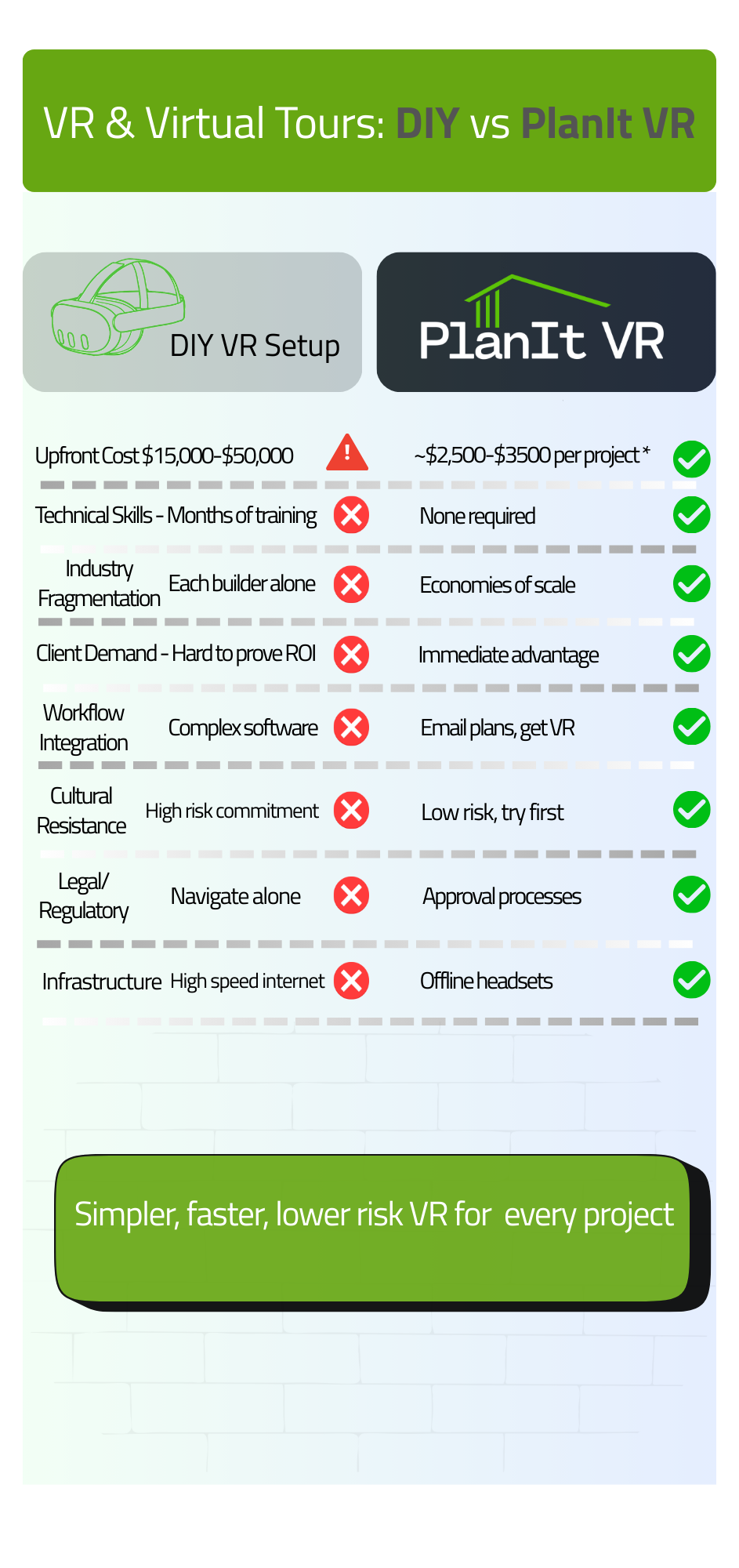
The common thread across all eight barriers is this: The challenges aren’t insurmountable—they’re just too expensive and complex for individual builders to solve alone. But when VR is delivered as a service rather than as a DIY technology stack, every barrier is broken down.
What Builders Are Seeing in the Real World
While virtual technology adoption in Australia is still low only 8-12% of builders are currently using it. Key overseas industry studies and academic research papers focused on Virtual Design and Construction (VDC) and VR based design reviews highlight some measurable benefits:
- Faster design sign-off: Clients finalise designs 40–60% faster with immersive walkthroughs [^1]
- Fewer costly variations: Mid-construction changes drop by 65–75% [^2]
- Happier clients: Post-build satisfaction scores increase by around 30% [^3]
- Stronger point of difference: Builders win more bids by offering premium visualisation
- More referrals: Clients are far more likely to recommend builders who use VR
While these results reflect experiences in other markets, there’s no reason Australian builders couldn’t achieve the same outcomes. With VR, clearer visualisation leads to earlier, more confident decisions — exactly what any builder wants.
Error Detection Performance
In practice, the immersive experience provided by a high-quality VR model delivers measurable advantages over full-scale floor plan projections or desktop 3D models.
Studies show VR users detect design errors 18–59% more effectively than those using traditional methods [^4], and this aligns with industry experience: stakeholders can evaluate electrical and plumbing layouts, tapware, wall and floor finishes, and window placement at true scale, while dynamically assessing natural light, shadows, and sightlines throughout the day. This heightened realism supports faster, more confident decision-making, reduces costly rework, and ensures stronger alignment between design intent and the final built outcome.
Key Point: You Don’t Need to Become a Tech Company
The Australian residential construction industry isn’t slow to adopt VR because builders are technophobes or lacking vision. It’s slow because the traditional path to VR adoption—buying hardware, licensing software, training staff, integrating workflows—is prohibitively expensive and complex for small businesses. But that path is no longer the only option.
Service-based VR providers like PlanIt VR are removing every barrier:
✅ No (or very limited) capital investment
✅ No technical expertise required
✅ No workflow disruption
✅ Pay-per-project pricing that scales with your business
✅ Professional-grade results that impress clients and win contracts
The question isn’t “Can we afford VR?” it’s “Can we afford NOT to offer it when our competitors do?”
Ready to See the Difference VR Can Make?
If you’re a builder tired of endless client revisions, mid-construction variations, and losing bids to competitors who offer more engaging design experiences, it’s time to explore what VR can do for you BUT without the $15K – $50K investment.
PlanIt VR creates photorealistic 3D models and VR walkthroughs from your floor plans at around $10-$15 per sqm. No hardware. No training. No hassle.
Learn more at PlanIt VR or contact us to discuss how VR can transform your next project.
Because the future of residential construction isn’t about becoming a tech company, it’s about partnering with one.
References
1. Girgin, S., Fruchter, R., & Fischer, M. (2023). “VR-Augmented Design Review.” Center for Integrated Facility Engineering, Stanford University. Retrieved from [https://cife.stanford.edu/next-design-workflow-transforming-project-workflow-through-vr-augmented-design-review](https://cife.stanford.edu/next-design-workflow-transforming-project-workflow-through-vr-augmented-design-review)
2. Girgin, S., Fruchter, R., & Fischer, M. (2024). “Construction Cost Savings Through VR-Based Early Identification.” Computing in Civil Engineering. Retrieved from [https://cife.stanford.edu/publications/process-collaboration/construction-cost-savings-through-vr-based-early-identification](https://cife.stanford.edu/publications/process-collaboration/construction-cost-savings-through-vr-based-early-identification)
3. Huang, Y., & Fukuda, T. (2022). “Impact of VR-Based Design Review on User Performance.” Applied Sciences, 12(14), 7249. Retrieved from [https://mdpi-res.com/d_attachment/applsci/applsci-12-07249/article_deploy/applsci-12-07249-v2.pdf](https://mdpi-res.com/d_attachment/applsci/applsci-12-07249/article_deploy/applsci-12-07249-v2.pdf)
4. Alizadehsalehi, S., & Yitmen, I. (2021). “Digital Twin-Based Progress Monitoring Management Model.” Journal of Construction Engineering and Management, ASCE, 147(7). Retrieved from [https://ascelibrary.org/doi/10.1061/%28ASCE%29CO.1943-7862.0002056](https://ascelibrary.org/doi/10.1061/%28ASCE%29CO.1943-7862.0002056)